



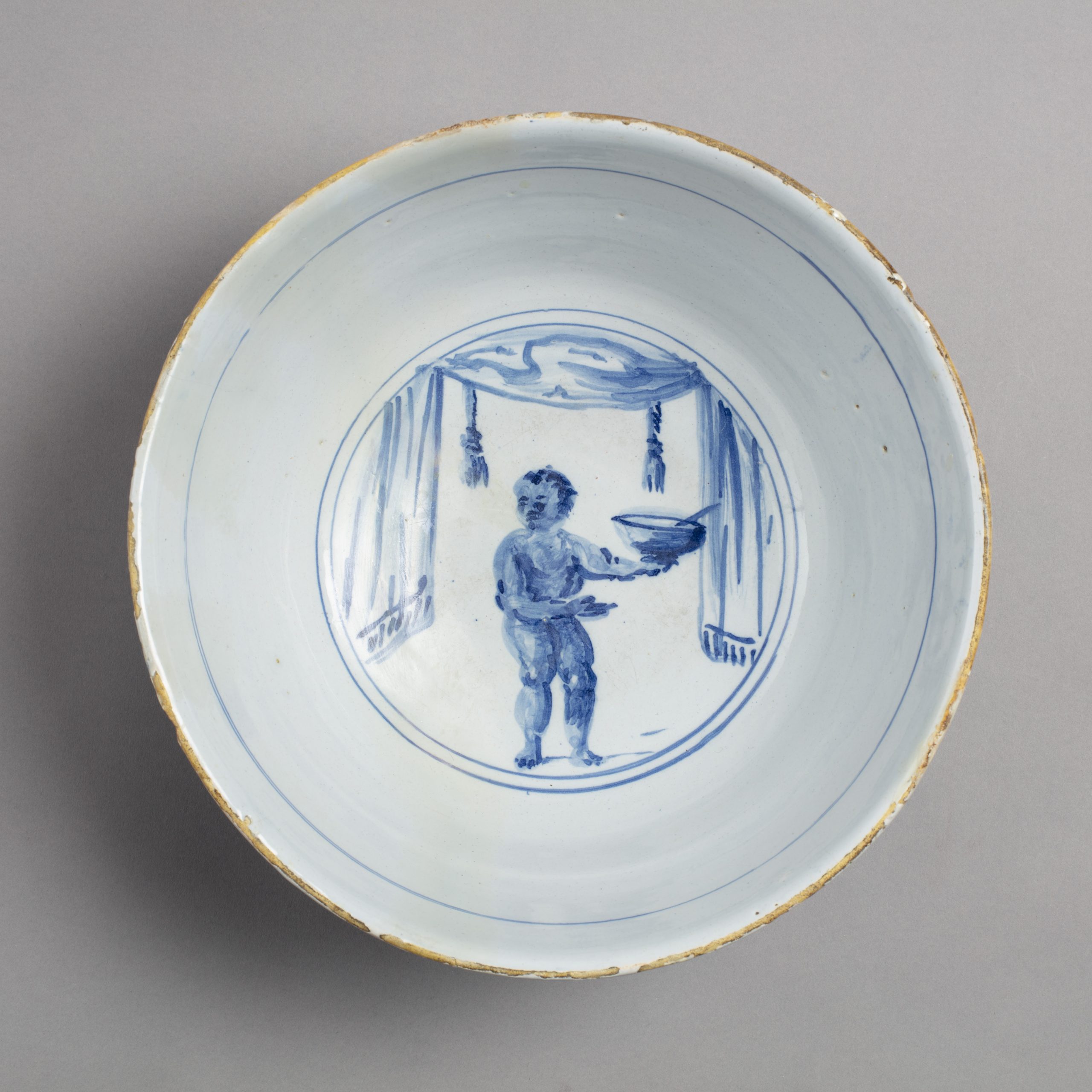
 We have recently acquired a rare delftware punch bowl, probably made in London or Bristol ca. 1750, with the support of the Friends. It has become part of Bristol’s large and important collection of English delftware and will be incorporated into a re-display which is scheduled for completion later this year. This is part of a two-year Arts Council England funded project to re-examine the collection.
In addition to enriching our delftware collection, the punch bowl introduces difficult themes of colonialism, enslavement and race in the eighteenth century and will allow us to explore these topics with our audiences. While the decoration on the exterior is a generic delftware landscape scene with a bridge, building, trees and figures, the depiction of a Black child presenting a punch bowl in the centre of the bowl is unusual and uncommon. As the punch bowl is an object associated with pleasure, festivities and excessive alcohol consumption, the depiction of the child is both troubling and thought-provoking. Images of Black servants and their presence within British homes can be found in prints, paintings, textiles and ceramics of the period. Here the figure is painted unclothed, infantilised – in a similar manner to many depictions of Black servants at this time who are usually depicted serving tea – and offering a punch bowl. The depiction of the child in this manner, and the use of the curtain as a framing device, highlights his role in serving and entertaining others.
At the time the punch bowl was made, the city of Bristol had and continued to acquire substantial wealth from the Transatlantic traffic in enslaved Africans and the trade of goods, such as tobacco and sugar, planted and harvested by enslaved Africans forced to labour in Britain’s American colonies and West Indian plantations. Earthenware made in Bristol, such as delftware, was exported to these places on a large scale in response to the growing population. Sugar and rum are key components of punch, the consumption of which increased as these commodities became widely available. It was mostly consumed by men in clubs and at other gatherings, which is illustrated in contemporary prints such as William Hogarth’s ‘A Midnight Modern Conversation’ (1733); a scene depicted on another punch bowl in our collection.
An object such as this may have been purchased for a particular business or building, such as a pub or an inn, possibly in Bristol. By the early 18th century images of Black people on trade signs, that hung outside shops and inns, and trade cards had become commonplace as a means to advertise goods or services. The stance of the child reinforces this as a possible explanation, as he appears to be offering or advertising the punch to the drinker. The bowl will enable us to address the history of punch drinking and its connections with British colonialism and the Transatlantic traffic in enslaved Africans for today’s audiences, while helping us to research the everyday objects that were made from which to drink it. Our approach will necessarily evolve as our decolonisation work continues, and we will be working with community groups to contribute towards interpretation and display strategies.